In this report, we analyze how exchange rate fluctuations affect the hospitality industry. We consider the case of Switzerland, which is a small, open economy located in the heart of the European monetary union. As you can see in Figure 1, Switzerland is characterized by a relatively high average degree of openness (measured as Exports + Imports over GDP).
Figure 1: Degree of openness of several countries, measured as the sum of exports and imports over GDP.
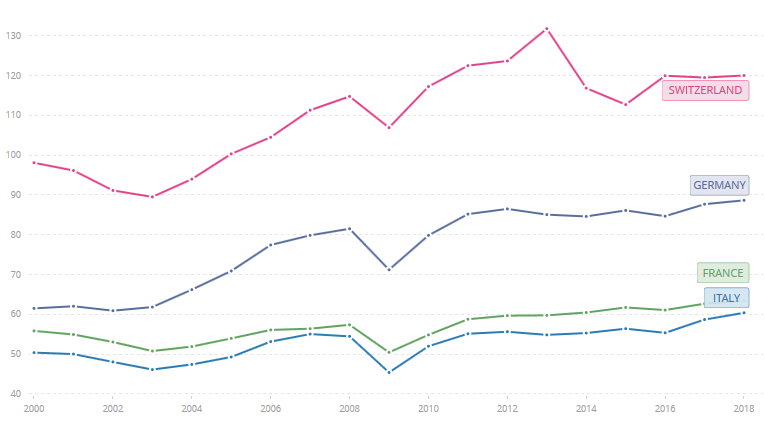
Source: World Bank
Switzerland's strong currency
If you compare Switzerland to larger countries like Germany, France or Italy, you can observe that Switzerland relies relatively heavily on foreign trade. Switzerland is a very special country, because, thanks to its stability, it has always been considered a safe haven, where international investors put their resources when there is economic turmoil and uncertainty in the rest of the world. The combination of these two features - a high degree of openness and a currency which has a tendency to appreciate - makes Switzerland a very interesting case study. Why? Because a strong currency reduces the ability of Switzerland to trade.
In general, exchange rate fluctuations affect any generic sector exposed to trade with foreign countries, as follows:
Table 1.
| Domestic Consumer | Foreign Consumer | |
| Strong Swiss franc | Increases domestic demand for foreign goods | Lowers foreign demand for Swiss goods |
| Weak Swiss franc | Lowers domestic demand for foreign goods | Increases foreign demand for Swiss goods |
In particular, Hospitality and Tourism industries fall into the category of export-oriented sectors because, essentially, they export services. When we export goods, we physically move a good from the country where it has been produced to a foreign country where it is going to be consumed. In the case of services, instead, we export a service whenever the consumer (resident in a foreign country, the tourist) physically goes to the country of the producer where he/she consumes the service. Consider for example a German resident going on holiday to the UK. Any night spent in a UK hotel is considered as an export from UK to Germany.
As explained in Table 1, a stronger Swiss franc not only reduces Germans’ incentives to go to Switzerland for their holidays, but also stimulates Swiss people to go to Germany for their vacation, given their relatively high purchasing power abroad.
Switzerland has historically been perceived as a “safe heaven”. During turmoil, investors have a tendency to buy Swiss francs which produces the effect of strengthening the currency. In Figure 2, we show an index which represents the exchange rate between the Swiss franc and several other currencies. An increase in the index is an appreciation of the Swiss franc. As you can observe, we had strong appreciations during and after the 2008 Great Recession, as well as during COVID-19 which was born as an health crisis but soon turned into an economic one.
Figure 2: Nominal exchange rate between the Swiss franc and a set of other currencies.
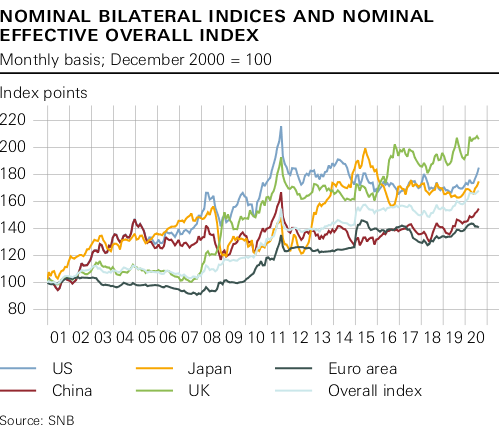
Figure 3: Exchange rate between CHF and euro.

Source: BCE.
The Swiss franc vs. the euro
If we focus more specifically on the exchange rate between the Swiss franc and euro in the period between 2000 and 2018 (Figure 3), we can see that in 2000 the exchange rate between CHF and euro was 1.6 (1.6 CHF for 1 euro), while starting from the world financial crisis in 2008, we observed a progressive strengthening of the Swiss franc. During the crisis, Switzerland was perceived as a safe haven, which explains why investors started to strongly buy Swiss francs. Such a high demand increased the value of the Swiss franc, which almost reached parity with the euro (1CHF = 1euro) in 2011. This is why the Swiss National Bank (SNB) intervened in September 2011, introducing a limit to Swiss franc appreciations with respect to the euro. With this intervention, the SNB committed to acting on the forex market with the goal of preventing the exchange rate going below 1.2 CHF for 1 euro. This intervention lasted until January 2015, when the SNB decided that it was time to let the exchange rate fluctuate freely. As you can see from the picture, that same day, the CHF strongly appreciated and reached parity with the euro (1 CHF for 1 euro).
Context: The rise and fall of currency exchange has a huge impact on international travel and tourism
- In general, we can expect that exchange rate fluctuations affect global travel and tourism (cost of travel, demand from international tourists, revenue of hospitality industry in general).
- But what does that mean for hotels?
- How do hotels respond to variations in currency exchange rates?
- Can currency exchange rates be proactively used by hospitality corporations as a business tool? Or, in other words, if we know how hotels with different features react to exchange rate fluctuations, can we can adopt specific business models in order to protect ourselves from that risk?
Having observed the fluctuations in hotel demand and pricing, we study whether these fluctuations are associated to exchange rate movements.
- In order to do so, we classify hotels by class (luxury, up upscale, upscale, up midscale, midscale and economy) and type of operation (independent, franchise and chain) and we analyze how the different categories of hotels respond to exchange rate appreciations.
- Additionally, we focus our attention on the intervention of the SNB and we study whether it affected the behaviors of hotels and clients between June 2011 and January 2015. Is it possible that pricing and consumption behaviors changed during the SNB intervention? Is it possible that agents (hotels and consumers) modified their behaviors knowing that the SNB was protecting them?
We can imagine that ADR and occupancy rate fluctuations are due to a number of components (class, operation + all the factors associated to the specific location + many other factors).
All the fluctuations which cannot be explained by the way hotel class and operation react to exchange rate must be due to additional factors specific to the location or to other shocks that hit the economy.
The facts
In the past ten years, the performance of hotels in the Swiss hospitality sector has gone through ups and downs. The three main Performance indicators are Average Daily Rate (ADR), Occupancy Rate and Revenue per Available Room. We classify Swiss zones as follows:
- Lake Geneva (including all the area of canton Geneva and Vaud)
- Central Switzerland (including the region of Lucerne)
- Northeast (including the Zurich area)
- Northwest (including Basel, Bern, Jura and Freiburg)
- Southeast (Ticino region)
- Southwest (Berner, Interlaken, Valais, Zermatt)
Figure 4

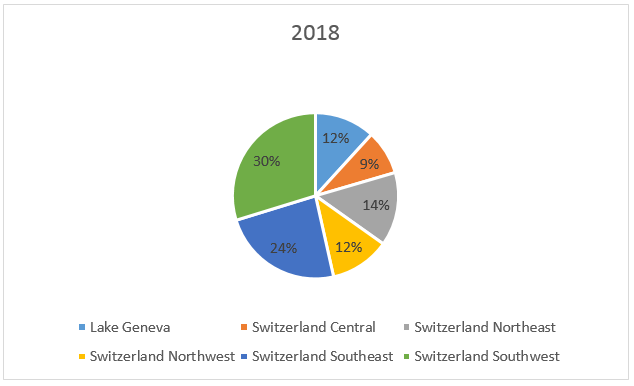
Figure 5: Distribution of hotels by region, 2018.
Source: STR
As you can see in Figure 5, the highest concentration of hotels is in the most touristic part of Switzerland (Southeast and Southwest).
On average, the three hotel performance indicators can be summarized as follows:
Table 2 : Descriptive statistics - by (market)
| Occupancy | ADR | RevPAR | |
| L. Geneva | 64.421 | 288.069 | 187.461 |
| Central | 63.806 | 162.355 | 105.574 |
| Northeast | 70.225 | 199.728 | 140.6 |
| Northwest | 63.485 | 182.524 | 116.728 |
| Southeast | 52.984 | 241.079 | 131.798 |
| Southwest | 58.259 | 197.379 | 115.557 |
Hotels situated in the Lake Geneva area are characterized by the highest average ADR and RevPAR, followed by northeastern and southeastern hotels. On the contrary, hotels situated in central Switzerland have the lowest performance in terms of average price and RevPAR. Occupancy is on average higher in the Zurich area and it is lower in the Ticino region.
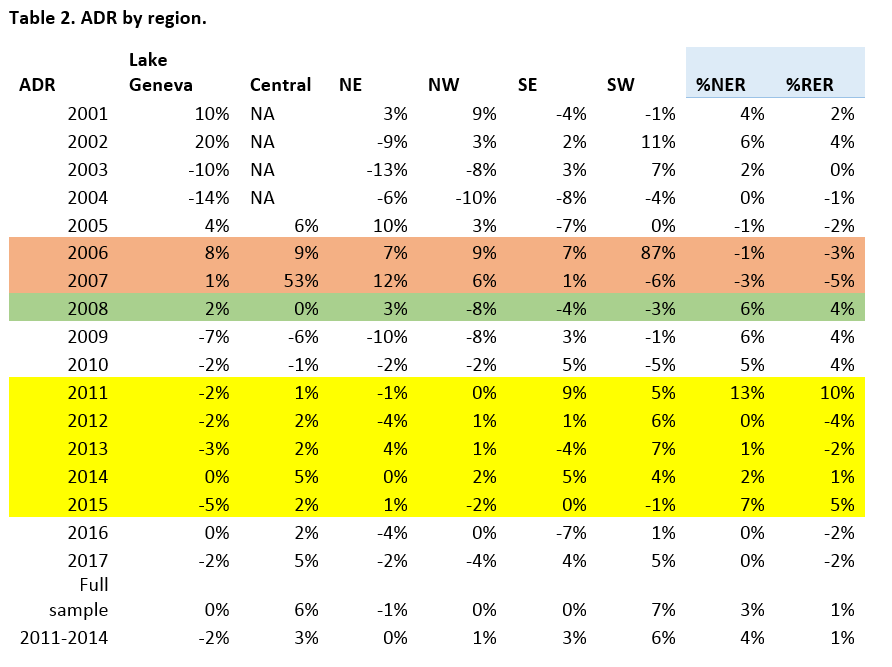
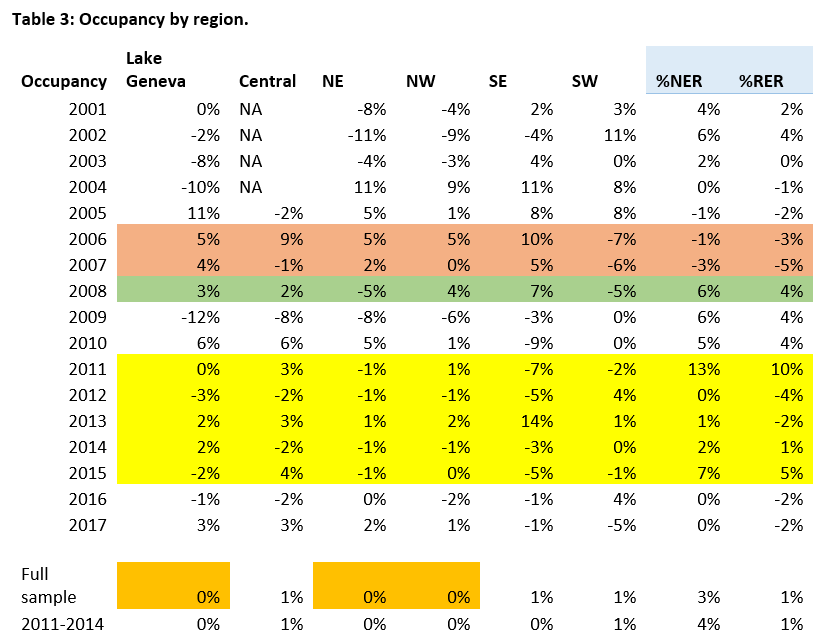
Over the period 2000-2018, we observed several fluctuations in ADR and Occupancy Rates, as well as in the exchange rate between the Swiss franc (CHF) and the currencies of the main Swiss trading partners (Figures 6 and 7 in the main text).
On average between 2001 and 2017, ADR increased by 7% in the mountain region of Switzerland (Southwest), by 6% in the central part of Switzerland, while it decreased by 1% in the northeastern area. If we focus our attention only on the period during which the SNB introduced a lower bound to Swiss franc’s appreciations, we find that ADR basically went up everywhere with the exception of the Northeast where it did not change and Lake Geneva where it went down by 2%.
As far as occupancy is concerned, we observe very small changes on average. It is worth noting that southern and central areas are the only ones experiencing on average a small increase over the full sample.
In this report, we look at the effects of exchange rate fluctuations on Swiss hotel performance in the period between 2000 and 2018. Performance indicators and exchange rates fluctuate over time, but can we find any significant relationship between their behaviors?
The most meaningful measure of exchange rate that we should consider is the real exchange rate (RER), which is the (nominal) exchange rate (NER) that we all know, adjusted by the relative prices of the countries considered. As you can see from Figure 6, NER and RER are in any case highly correlated.
Figure 6: ADR and exchange rates fluctuations.

Figure 7: Occupancy and exchange rates fluctuations.

A Swiss franc appreciation provokes the following results:
- Hotels’ reactions are driven by a very strong local component. The location (distance from the border, north or south/town or vacation spot) affects their pricing behavior in an important way.
- Hotels’ ADR tend to decrease after an appreciation of the Swiss franc, especially in the Geneva area, in the Northeast and in the Northwest. Instead, the effect of exchange rate appreciations is less perceived in the center of Switzerland and in the touristic areas of Ticino and the Southwest (mountain region) of Switzerland.
- Occupancy does not seem to react in an important way to exchange rate appreciations. We only observe an increase in occupancy in the central part of Switzerland, which is also the cheapest one.
- RevPAR is strongly driven by ADR. Those regions that react the most to exchange rate appreciations, also observe a stronger reduction in their revenue per available room.
Impact of SNB intervention
- Our tests seem to suggest that pricing decisions are strongly affected by the SNB intervention.
- More precisely, we observe that the Geneva region, the Northeast and Northwest tend to use strategically the intervention of the Central Bank. During the intervention period, ADR did not decrease following a RER appreciation in these areas. The awareness that the Central Bank was limiting exchange rate appreciations (i.e., the awareness that the SNB was protecting them), reduced their reactivity to currency risk.
- These same regions strongly react a lot to Swiss franc appreciations by reducing their ADR, when the exchange rate is completely free to fluctuate (no protection from the monetary authority).
- Central and southern regions paradoxically seem to do exactly the opposite of northern regions & Geneva area. During the SNB intervention, they reduced ADR following exchange rate appreciations, while when the exchange rate was free to fluctuate, they did not change their ADR in any significant way.
- Interestingly enough, central and southern regions seem to react more to northern regions’ behavior than to the exchange rate itself. It is as if zones on the border were competing with foreign countries, while central and southern Swiss regions were competing with northern Swiss regions, plus lake Geneva.
- The behavior of occupancy is overall not importantly affected by monetary policy.
Potential reasons
- Northern areas and Geneva region seem more exposed to international competition. That is why they react more strongly to exchange rate appreciations.
- These same regions seems to act strategically and respond to exchange rate fluctuations only when they are not protected by the central bank intervention.
- Central and southern regions react less to exchange rate fluctuations and seem more concerned about the behavior of the richer Swiss areas (also because these regions - with the exception of Ticino - are much cheaper than the rest of Switzerland to begin with).
Hotels by class. Do different classes react differently to the same exchange rate appreciation?
- An exchange rate appreciation is, in general, associated with a reduction in ADR in all classes.
- Nevertheless, luxury and upper scale hotels are more immune to exchange rate variations (they reduce their ADR less), while economy and midscale hotels react more.
- Occupancy rates do not seem to be associated with exchange rate fluctuations. The only exception is represented by luxury hotels, which suffer from a reduction in occupancy.
- Overall, RevPAR decreases for everybody but in a stronger way for lower class hotels (due to their stronger ADR reductions).
Impact of SNB intervention
- We observe an important impact on ADR and RevPAR.
- During the intervention period, ADR increases instead of decreasing, especially for higher classes. The economy class ADR does not seem to change significantly, while luxury hotels act strategically and consider the importance of monetary policy.
- In the non-intervention period, ADR is negatively correlated with exchange rate appreciations for all the classes, especially for the lower ones.
- In the non-intervention period (no protection), occupancy goes down for all the classes and especially for the luxury class. Consumers react to the exchange rate risk by lowering demand.
- During the intervention period (protection), only the luxury class occupancy is affected by the exchange rate. All the other classes do not experience significant changes in occupancy. Consumers seem to be reassured by monetary policy.
- RevPAR increases in the intervention period (especially for the luxury class) and decreases in the non-intervention period (especially for the economy class).
Potential reasons
- Higher classes act more strategically than lower ones when it comes to prices. In general, occupancy does not seem to move a lot, especially when the monetary policy limits exchange rate appreciations.
- Luxury class hotels show to be the most sensitive to quantity demanded (the quantity of rooms sold decreases especially in luxury classes).
- However, clients who keep going to luxury hotels do not mind paying relatively high prices even during exchange rate appreciations. As a result, (a bit less quantity sold but a price that is relatively high), in general, the luxury class seems able to respond well to exchange rate fluctuations.
What should a hospitality professional know? Key takeaways
- Luxury class hotels respond less to exchange rate appreciations and, thanks to their strategy, manage to contain their losses in terms of RevPAR.
- Occupancy does not move a lot and, therefore, it is never a good idea to react to exchange rate appreciations with strong ADR reductions.
- Additionally, luxury hotels (and higher classes in general) are very good at using market shocks at their advantage. When the Swiss franc is free to appreciate (which can be interpreted as a negative shock) they reduce ADR but in a very limited way. When Swiss franc appreciations are controlled by the Central Bank (good news), they use the optimism generated by this policy to strongly increase ADR.
Do hotels classified by operation (independent, franchise, chain) react differently to exchange rate appreciations?
- Independent hotels do not seem to react to exchange rate appreciations (not able, not used to read market signals?)
- On the contrary, chains and even more franchised hotels reduce their ADR when the exchange rate appreciates (more sophisticated in their decisions and probably more international perspective).
- The occupancy rate increases in franchises but even more in chains, when the exchange rate appreciates. While it does not show any specific effects on independent hotels.
- Overall, RevPAR decreases in franchised hotels, while does not change in independent hotels and chains.
Impact of SNB intervention
- We do not observe any impact associated to the SNB intervention. The relationship between occupancy, ADR and exchange rate seems to be stable over the whole period.
What should a hospitality professional know? Key takeaways
- Franchises and chains both react to exchange rate appreciations by reducing ADR. However, franchises’ intervention is too strong and does not manage to be balanced by an increase in occupancy.
- In general, it is important to change prices in response to shocks. However, hotels should always remember that quantities (occupancy) are relatively rigid. As a result, prices should be weakly reduced in response to a negative shock and strongly increased in response to a positive shock.
Conclusion
Our findings are based on a limited sample which is biased towards luxury hotels and chains.
Hotel performance is surely related to local factors which go beyond hotel class and operation (business model). Northern areas of Switzerland seem to be more exposed to international competition and react more to exchange rate fluctuations. Southern and central areas are more touristic, but somehow seem more protected from international competition. One reason might be that their prices are relatively low with respect to the average Swiss hotel price (central Switzerland) or another reason might be that their demand is quite rigid (Ticino for example has a relatively high average ADR and does not show any intention to reduce it because of exchange rate appreciations. Mountain regions have an average ADR but a relatively low occupancy).
Nevertheless, our results seem to suggest that chains and higher class hotels (luxury, upscale) have a better ability to insure themselves against exchange rate fluctuations. If necessary, independent hotels also limit their losses, but in a way that is different from chains. Independent hotels simply do not react to shocks at all, while chains are more prone to change prices in response to market forces.
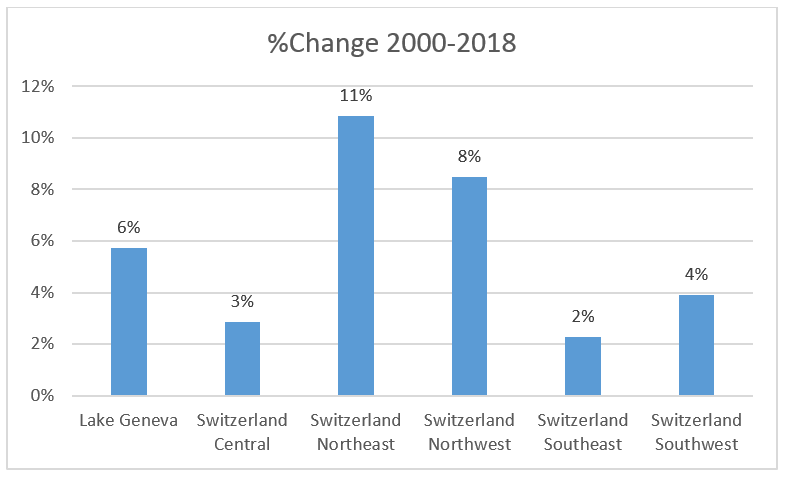
Data suggest that over time the market is expanding in a stronger way in the regions that better react to exchange rate appreciations (Figure 8): Lake Geneva and Northern Switzerland. In fact, even if during the last decade hotels in this region had to face some negative shocks that implied some losses, we should always remember that, on average, their performance is well above the one of all the other parts of Switzerland.
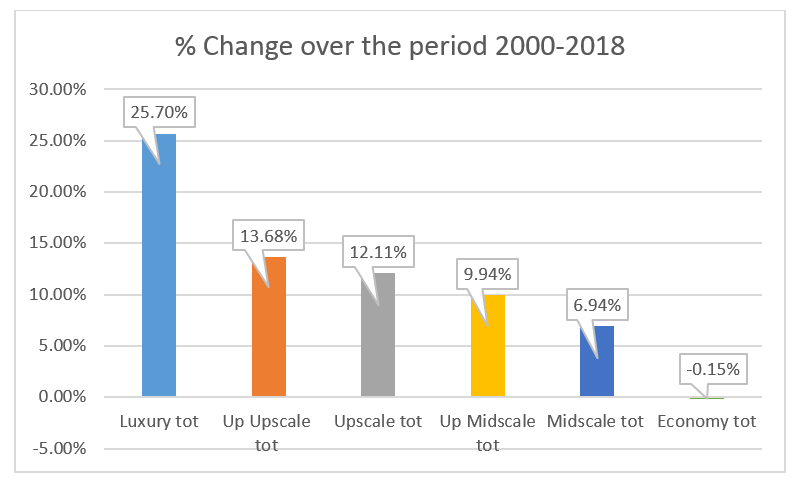
Similarly, we observe in the last twenty years an important increase in luxury and upper scale hotels (Figure 8), and chains (Figure 9), which seems quite consistent with our results.
Figure 8: Evolution of hotels by region, between 2000 and 2018
Source: STR
Figure 9: Evolution of hotels by scale, between 2000 and 2018
Source: STR
We also observe a larger increase chains and franchises, rather than in independent hotels, which still represent the vast majority of hotels in Switzerland.
Figure 10: Evolution of hotels by scale, between 2000 and 2018

Source: STR
The present study was conducted before COVID-19, using data between 2000 and 2018. Nevertheless, its main implications may still apply now. During the first months of this health crisis that soon turned into an economic crisis, the Swiss franc in fact showed a tendency to appreciate towards most of the currencies (Figure 2), replicating a situation similar to the one that we observed during the 2008 crisis. Future research will have to delve deeper into the analysis to understand whether the recent franc appreciations produced similar results on the hotel industry as the ones that we observed during and immediately after the Great Recession of 2008.
Appendix