
Could it be time to revolutionize the way we lead? With employee expectations changing and the younger generation currently searching for a greater sense of purpose, what does this mean for those in charge of leading and motivating the task force? Today’s leadership models are in need of being informed by new values, systems and criteria for reinventing what the pillars of success are really based on: human capital. Building a company culture that is human-centric creates the right environment to develop leadership soft skills which in turn help to inspire greater engagement, loyalty, productivity and enhance overall business performance.
Culture, culture, culture!
A few decades ago, hospitality businesses started adopting a catchphrase from the world of real estate: “Location, location, location!” Setting up in the right spot was considered to be one of the main factors in a hospitality firm’s success story. Today I’d like to re-invent the slogan and change it to quite simply “Culture, culture, culture!” Why? Because changing the attitudes towards the attractiveness of our industry and its leadership styles is what will incentivize a new generation of workers to join and remain in this sector. Communicating and delivering on a workplace culture that is employee-driven is where the competitive advantage lies. Why would a bright, savvy Gen Z job seeker be interested in your company otherwise?
The post-Covid landscape which we find ourselves in is populated by new employee expectations that are quite rightly asking for a more human-centric approach. Traditional leadership models that focus solely on profit margins at the expense of investing in human capital will not be able to attract and keep a talent pool geared for longevity, productivity and success. Developing employee-centric leadership models that promote human values and a positive company culture is the starting block for reinventing the new paradigms that hospitality is so in need of. QUOTE DE M VENZIN + QUOTES DE M.LEVIE + ACHIM en Carousel
Culture that reflects the changes in employee expectations
It could be argued that traditional post-war culture and leadership models had never been threatened until the Covid pandemic came along to question a top-down system whose time was up. By contrast, modern-day working requirements very much reflect the need for basic human values, and what’s more, the ubiquitous digitalization of our society has only reinforced the need for human-centricity, genuine interaction and a sense of belonging.
Business dynamics have changed, and today, I see employee expectations now including:
Building a strong company culture is the foundation upon which these expectations can evolve, consequently, it involves more than a nice CSR statement with a publicity intention. Culture needs to be aligned and communicated clearly among leaders, employees, end consumers – in brief, all stakeholders. But most importantly, it needs to be built with a certain methodology in mind that ensures credibility, workability and measurability. For me, these are the important questions that need to be asked:
The benefits of creating a strong company culture should be the drivers of this paradigm shift. Employee engagement spurred on by a growth plan, an innovation mindset, fair hours, empowerment and transparency – this is, today, how companies differentiate themselves in the marketplace and position themselves as attractive, forward-thinking places of work where talents want to remain and flourish.
Employee-centric culture impacts the bottom line by creating a virtuous circle where engaged workers deliver better results, leading to satisfied customers and greater business productivity. To quote the ever popular Simon Sinek: “Happy employees ensure happy customers. And happy customers ensure happy shareholders – in that order”.
Smart leadership skills
Strong organizational culture hangs very much upon the leaders who understand that it’s important to walk the talk. This requires a specifically agile and soft skill mindset that prioritizes qualities such as humility, active listening, empathy and adaptability that allow employees to feel they can ‘be themselves’ in the workplace. Infographic taken from
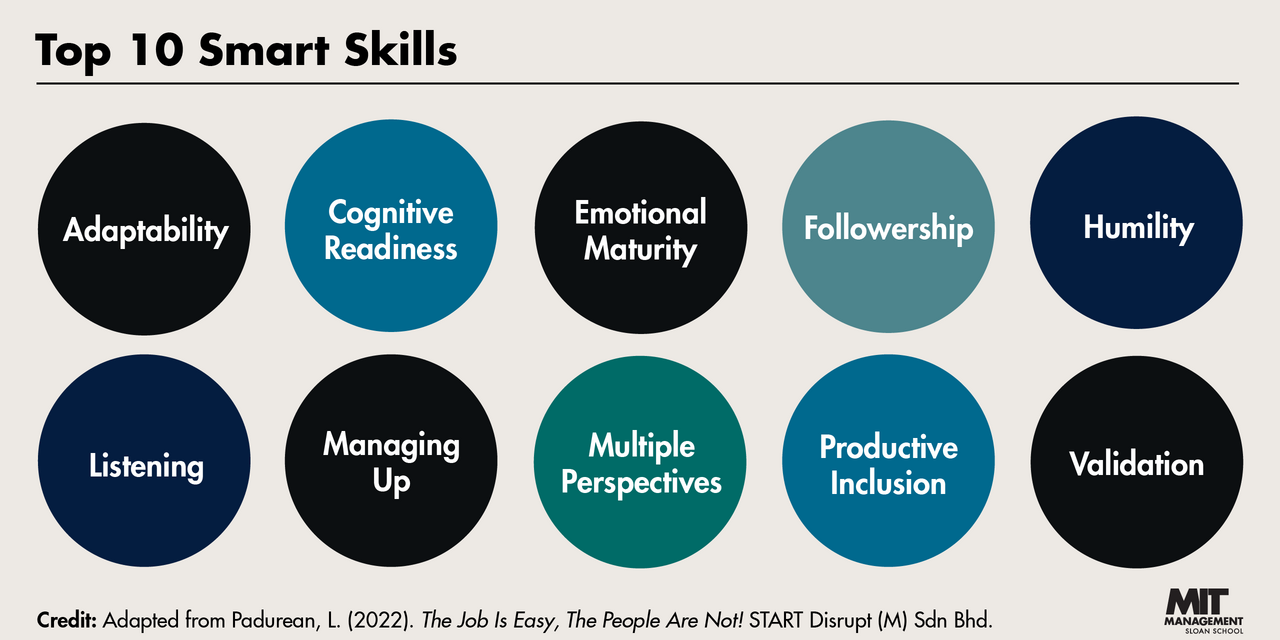
These “smart skills” are as essential for successful business outcomes as knowing how to manage a P&L statement or clinching a lucrative deal. Since human capital (i.e., people) is a deeply complex variable, it is important for leaders to be trained in effective communication, emotional intelligence and motivational incentives for bringing out the best in teams. The open implementation of these ‘intangible’ human skills is what communicates to employees a sense of psychological safety in the workplace culture; once this is in place, you have a fertile terrain for engaged, loyal and creative productivity.
Learnable skills with proven outcomes
Recent studies highlight that developing soft skills has become a top priority for business leaders in 2023. Research carried out in the US across 22 industry sectors revealed that soft skills are the most desired qualifications for 91% of management jobs. According to a Business Solver survey, 76% of employees believe an empathetic organization inspires more motivated employees. Forbes claims that the development of soft skills is key to future proofing one’s career, listing durability, resilience and productivity as to why, above hard skills, they count the most in today’s workplace.
These “smart” qualities are profoundly learnable, practicable and highly transferable across all types of industry that rely on a customer service exchange, (healthcare, banking, real estate, luxury to name but a few). In fact, the sign of a motivated workplace culture is one that invests in its employees’ leadership skills and builds a skill-based strategy aligned with its business objectives where opportunities for growth are identified and encouraged.
EHL’s Graduate School welcomes business leaders from a rich variety of industry sectors to impart not just the EI skills associated with hospitality excellence, but above all, new attitudes to employee-centric approaches, such as servant leadership, transformational leadership and human skills. Training leaders in human-centric management techniques is even more at the forefront as we enter into the 4th industrial revolution.
At a time where the question of AI dominance comes with an ambiguous set of pros and cons, I believe that it is in the harnessing of these human smart skills that we can create AI-proof careers. Human-centric leadership is the new must-have for today’s managers. Relying solely on digital technologies to create a competitive advantage is not where the magic formula for future business success lies. Digital connection is undeniably a big thing, but – because of it and not in spite of it - human connection ultimately reigns since human capital remains a company’s greatest asset.